Klev Schoening
The ClimbKlev Schoening’s role in the 1996 Everest disaster turns on a reversal: introduced as a gifted but untested client, he repeatedly becomes a source of steadiness when experienced climbers and guides are overwhelmed. He helps lower a stricken Sherpa during acclimatization, reaches the summit, and then, lost in the storm with a group of exhausted climbers, helps orient them and keep them together. His story makes the distinction between athletic strength and judgment under pressure central to his place in the expedition.
Identity and Background
Thirty-eight-year-old Klev Schoening joined Mountain Madness with his uncle, Pete Schoening. He came from Seattle and was a former nationally ranked downhill ski racer, a strong athlete who maintained his conditioning through frequent climbs in the Cascades. He had never summited an 8,000-meter peak, however, and was notably less experienced as a climber than his uncle. Scott Fischer called him a “big, strong young buck,” a description that captured both his physical promise and the uncertainty surrounding how he would fare at extreme altitude.
That uncertainty shaped the guidance Klev received. Anatoli Boukreev saw that the younger man’s competitive instincts and desire to lead could work against him on a high-altitude climb. Boukreev repeatedly urged him to pace himself and conserve energy, warning that reaching the top first was not the point. Klev’s fitness, particularly while using oxygen, could make his reserves seem limitless even when they were not. The expedition’s account thus introduces his strength as an asset that also required restraint.
Rescue Work During Acclimatization
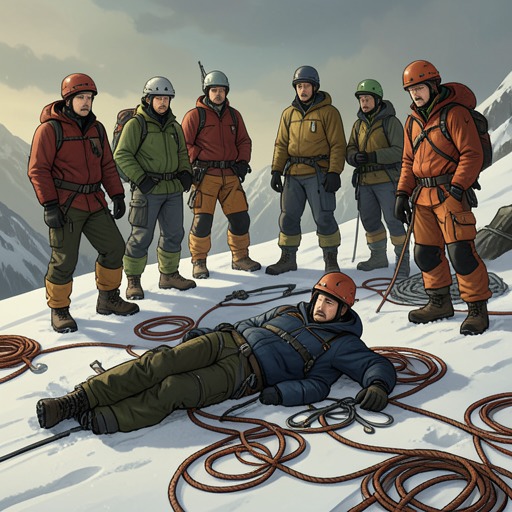
Klev’s first major test came not on a summit push but during a medical emergency above Base Camp. When Ngawang Topche Sherpa developed high-altitude pulmonary edema at Camp II, there were no Mountain Madness guides there: Fischer had left, while Boukreev and Neal Beidleman were resting at Base Camp. Klev and Tim Madsen, who had gone up to continue acclimatizing, were left to coordinate the immediate response. Boukreev’s advice by radio was unequivocal: get Ngawang Topche Sherpa down as quickly as possible and give him oxygen.
The Sherpa was not responding to treatment, so Klev and Madsen improvised a sled and began lowering him. Beidleman and several Mountain Madness Sherpas left Base Camp to meet them on the route through the Khumbu Icefall. Just before dark, Beidleman and the Sherpas took over the descent; Klev and Madsen remained on the mountain to continue their acclimatization. The rescue established a pattern that recurred on summit day: faced with an emergency, Klev acted practically, and his contribution was part of a larger relay of effort rather than a solitary feat.
Summit Push and the Summit
Boukreev’s advice about conserving energy followed Klev into the climb. He considered the younger climber aggressive, perhaps too eager to push ahead, and doubted that Klev had fully absorbed the instruction to save his strength. On the route to Camp III, Boukreev and Fischer discussed the clients’ fitness and the risks of altitude, including Klev’s tendency to press on. The warning acquired significance later: physical conditioning could help a climber move efficiently, but it could not remove the need to judge effort and conditions.
Klev nevertheless reached the summit. At about 1:45 P.M., after coming over the final rise, he was photographed by Boukreev. With his hands raised in celebration, he approached the aluminum tripod marking the true summit and soon began to cry. In a later account, Boukreev said that Klev and Martin Adams were the only Mountain Madness clients he saw summit while he waited at the top. Klev’s achievement was therefore both intensely personal and part of a worrying pattern: other clients were still not appearing, and Boukreev had no radio link to those below.
Klev’s ascent also unfolded amid mounting urgency. At the South Summit, he encountered Jon Krakauer in distress and stayed long enough to see that guides were beside him, though Klev believed he could do little to help. When Beidleman arrived, he told Klev to get moving, emphasizing the lateness of the hour and the threat of the storm. Klev later recalled that this prompted him to leave. His account complicates any simple image of him as either an impulsive competitor or a self-sufficient rescuer: he paused out of concern for another climber, then accepted a guide’s urgent direction to descend.
The Blizzard and the Lost Climbers
During the descent, Klev and Lene Gammelgaard moved quickly together. Gammelgaard trusted him and felt that they shared a way of being on the mountain. When she was running out of oxygen and her face had turned blue, Klev stopped her and made her take some of his supply, even as she insisted that she did not need it. Their haste and mutual reliance did not keep them on the right route. At the end of the fixed ropes, they saw a large mass of lights to their left and joined that group, later recognizing that the choice had taken them in the wrong direction.
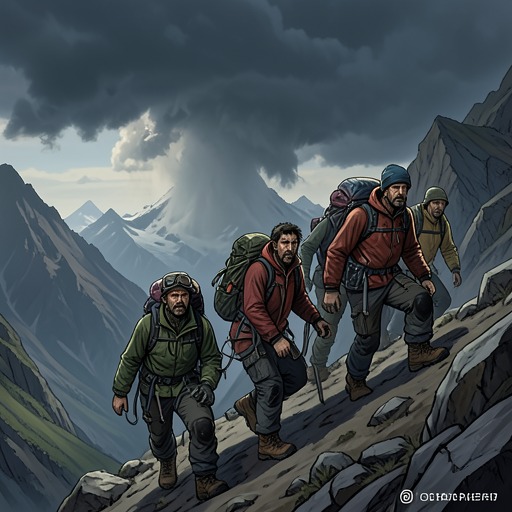
The climbers gathered in the storm had little visibility, failing communication, and no clear leader. Beidleman recalled that he was arm in arm with Yasuko Namba and could not get his headlamp from his pack; he believed Klev and Gammelgaard had already headed toward Camp IV. As the group became increasingly desperate, Gammelgaard began to look to Klev to get them out, judging Beidleman to be disoriented. During a break in the storm, Klev found his bearings and insisted that he knew which way the camp lay. Beidleman recalled repeatedly asking whether Klev was sure; Klev remained positive and identified the route as uphill, in the direction opposite the one from which they had come.
Klev’s calm mattered as much as his orientation. Gammelgaard remembered him as steady and realistic while others were close to panic: he focused on what could be done rather than treating the situation as an inevitable disaster. The account explicitly links this moment to his earlier rescue work, presenting him as someone who rose to the occasion and helped keep order in the group. His composure was not a claim that the danger had passed; the group still had to decide who could move and whether to leave those who could not.
The physical limits of that decision were severe. Beidleman recalled trying to get everyone upright and rearranging who supported whom, but some climbers could not walk unsupported. Klev helped keep people moving and was later among those Beidleman remembered yelling for the group to stay together. Beidleman described how wind and darkness erased familiar terrain: the group wandered, lost its orientation, and feared that leaving one another would mean being lost altogether. On ice broken by protruding rocks, with gusts that could knock climbers down, he saw a dip ahead that seemed dangerously out of place and returned to the group. The group eventually huddled with its backs to the wind, using bodies, movement, and mutual checks to stay warm and awake.
A brief clearing offered a chance to find direction. Beidleman remembered stars appearing, then the Big Dipper and the North Star; someone identified Everest, and Klev, according to Beidleman, became certain of the direction to camp. The group stood and started uphill, though it split as some people could move and others could not. In Beidleman’s recollection, the decision to try to reach camp came with fear and urgency. Klev’s confidence provided a usable direction amid uncertainty, but it did not make the route safe or the group’s condition uniform.
The climbers eventually saw a headlamp near the tents: Boukreev and another person, whom Gammelgaard identified as Pemba. They reached the tents and fell in front of them. Boukreev helped remove their crampons and directed them into different shelters. Klev’s role in bringing the group toward camp did not end the peril by itself; rather, it helped turn a scattered, disoriented mass into climbers who could reach the guides and shelter.
Testimony and Narrative Significance
Klev later recounted the disaster as a participant in the Mountain Madness debriefing, tape-recorded on May 15, 1996, five days after the storm. The meeting included the expedition’s guides, sirdar, doctor, manager, and six clients; Charlotte Fox was absent after being airlifted for medical treatment for frostbite. When the group discussed whether to abandon the recording and take notes instead, Klev objected. Martin Adams worried that every word on tape could be interpreted against them, while Ingrid Hunt argued that recording was more likely to preserve the whole story. Klev’s objection places him within the expedition’s post-disaster struggle over how an account should be made and judged.
His recollections also became part of a later dispute about the use of the debriefing material. Jon Krakauer said Klev and Beidleman had complained that statements used in The Climb were taken out of context and misconstrued. In response, the book’s authors noted that they had communicated with both men before the mass-market paperback appeared in July 1998 and that neither had challenged a specific detail or proposed a change. The disagreement highlights how Klev’s testimony served two functions: it recorded a participant’s memory of events and became evidence in a contested account of those events.
As a character in the disaster narrative, Klev is defined less by summit attainment than by the change in what others need from him. His athleticism first marks him as a promising but inexperienced client, and Boukreev’s repeated warnings frame the risk of confusing strength with inexhaustible energy. In the emergency, however, Klev helps lower a sick Sherpa, gives Gammelgaard oxygen, and helps orient a lost party when the storm has stripped away ordinary landmarks. The movement from being cautioned to conserve his own strength to helping others endure the night gives his arc its distinctive force: practical judgment, calm, and shared effort become more consequential than being first to the top.